Fishin' Frenzy: mechanics, numbers, and the mistakes no one mentions
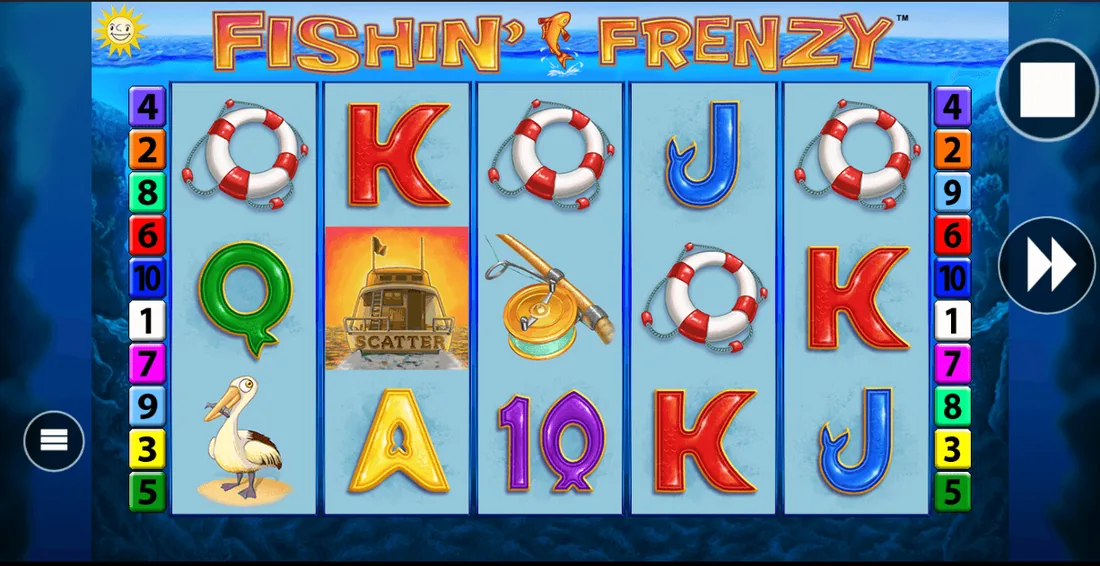
The most expensive mistake in Fishin' Frenzy? Chasing the free-spins feature straight after you've just triggered it. The mathematics don't care that you've seen the fisherman collect prizes once—each spin is independent, the feature frequency stays around 1 in 167, and burning through your balance trying to force a second trigger is how sessions end badly.
This page walks through how the game actually works: the round structure from stake to payout, how multipliers build, what the RTP and volatility mean in practice, where the £5 and £2 stake caps apply, and the step-by-step controls. You'll also see where it runs as a demo, which UKGC-licensed operators carry it for real money, and how it behaves on a phone screen.
Why new players misjudge the free-spins frequency
Fishin' Frenzy is a 5×3 video slot with 10 fixed pay-lines, built by Blueprint Gaming. The base game pays left-to-right for matching symbols—fisherman, rod, tackle box, lifebuoy, four card ranks—and the pelican scatter triggers the bonus. Land three or more pelicans anywhere on the grid and you're awarded ten free spins with a prize-collect mechanic: every fish symbol that lands shows a coin value, and if the fisherman appears on the same spin he collects all of them and adds the total to your win.
The mathematics: RTP sits at 96.12 per cent when you play all ten lines, volatility is medium, and the feature hit rate averages 1 in 167 spins. That last number is the one that trips people up. After a bonus round, the brain registers the event as «recent» and expects another trigger soon. The RNG doesn't track history—your next 167 spins have the same 1-in-167 chance on every individual spin, so you can easily go 300 or 400 spins dry. Medium volatility smooths the ride compared to high-variance slots, but it doesn't eliminate cold streaks.
The second common error: assuming the free spins guarantee profit. They don't. If fish symbols are sparse or the fisherman doesn't land, you can walk away with £2.00 from a £1.00 trigger stake. The feature's value comes from the ceiling—stacked fish and repeated fisherman appearances can push a single bonus into three-figure wins—but the floor is close to zero. Volatility works both ways.
How a round runs, from stake to collection
- Set your stake: the slider or plus/minus buttons adjust the total bet per spin, covering all ten lines. Blueprint's default range runs £0.10 to £10.00, but UKGC stake caps override that—£5.00 maximum for players aged 25 and over, £2.00 for 18–24 year-olds. The game client reads your age from the account verification data and enforces the cap automatically.
- Spin: press the circular arrow or tap the screen on mobile. The reels stop in under two seconds. If you've matched three or more symbols on any of the ten lines, the win animates and the amount updates in the balance box. No match, the stake deducts and the next spin is ready.
- Free spins trigger: three, four or five pelican scatters award ten free spins regardless of position. The screen transitions to a harbour backdrop. During these ten spins, fish symbols carry cash values—typically 2× to 20× your triggering stake per fish. If the fisherman lands on reel five, he collects every fish value visible on that spin and adds the sum to your feature total.
- Feature end: after ten spins the game returns to the base mode and credits the feature win to your balance. You're back at step one.
Autoplay: tick the auto-spin icon, choose 10 to 100 spins, and set optional loss and single-win limits. The game will stop automatically if you trigger the feature, hit a limit, or run out of balance. You can cancel autoplay mid-cycle by tapping the stop button. Turbo mode speeds reel movement but doesn't alter RTP or outcomes—it just shortens the animation time.
RTP, volatility, and what the long term actually looks like
Return to player of 96.12 per cent means the game is programmed to pay back £96.12 for every £100 wagered, calculated over millions of spins. Your personal session will not mirror that average—variance ensures some players finish ahead, most finish behind, and the further you stray from the mean, the smaller the sample. A hundred spins is noise; ten thousand spins starts to approach the theoretical curve.
Medium volatility: wins arrive more frequently than in high-variance slots, but the top prizes are correspondingly smaller. The maximum win in Fishin' Frenzy is 5,000× your stake, reached when the feature delivers an exceptional combination of stacked fish and multiple fisherman collections. Compare that to high-volatility games offering 10,000× or 20,000× max wins—the trade-off is that those big wins are far rarer and the base game pays less often.
Where Fishin' Frenzy sits in Blueprint's catalogue and how it compares
Blueprint released Fishin' Frenzy in 2014, and it became one of the studio's signature titles—popular enough to spawn sequels and spin-offs. Fishin' Frenzy Megaways adds the variable-reel mechanic and raises the max win to 10,000×, but volatility climbs to high and the feature becomes harder to trigger. Fishin' Frenzy Prize Lines replaces the free-spins round with an instant-prize pick game. The original remains the most-played version, likely because the medium volatility and straightforward bonus suit casual sessions.
The game's design is deliberately simple: no cascading reels, no progressive multipliers, no buy-bonus option. The only variable in the feature is how many fish land and whether the fisherman collects them. That lack of complexity makes it easy to understand but also means there's no skill element or decision tree—you set the stake, spin, and wait. Players who want layered mechanics or higher ceilings tend to move on quickly; players who value transparency and consistent pacing stick around.
One mechanical quirk: the fisherman only collects on reel five, so if fish symbols land on reels one to four without a fisherman on five, they pay nothing beyond their base symbol value. It's a common frustration in the feature—three or four fish visible, no collection, and the spin contributes almost nothing to the total. The game's RTP accounts for this, but it feels punishing in the moment.
Playing on mobile, demo access, and real-money operator checks
Fishin' Frenzy runs in HTML5, so it launches in any modern mobile browser without a download—Safari on iOS, Chrome on Android, whatever your phone's default is. The 5×3 grid fits portrait and landscape orientation; portrait keeps the controls within thumb reach, landscape gives you a wider view of the reels. Load times are under three seconds on 4G, the touch targets for spin and stake adjustment are large enough to avoid mis-taps, and the game saves your session if you background the browser or lock the screen.
Demo play: Blueprint allows operators to offer a free-play version, and most UKGC-licensed sites host it. You'll need to create an account and pass age verification—18 minimum—before the demo unlocks, because the Gambling Commission requires operators to restrict all gambling content, including free play, to verified adults. Once logged in, look for the «Demo» or «Play for Fun» toggle on the game page. The demo uses virtual credits, infinite balance, and identical RTP and mechanics to the real-money version. It's the cleanest way to learn the controls and see the feature without risking your own money.
Real-money play: every operator serving players in the United Kingdom must hold a remote gambling licence from the UKGC. Before you deposit, check three things. One: the licence number in the website footer—it's a five or six-digit reference. Two: look up that number in the UKGC public register to confirm the operator's legal name and licence status. Three: read the site's terms for withdrawal times, document requirements, and bonus wagering. The register search takes 30 seconds and filters out unlicensed sites, which are illegal to use and offer no consumer protection if something goes wrong.
- Payments in: debit card (Visa, Mastercard), PayPal, Apple Pay, Open Banking via Trustly, paysafecard. Credit cards have been banned for gambling since April 2020.
- Payments out: e-wallets process in a few hours to 24 hours, Faster Payments to your bank take same-day to two working days, debit-card withdrawals take one to three working days.
- KYC: operators verify age and identity before you deposit, then request documents—passport, driving licence, proof of address—before the first withdrawal. Processing takes 24 to 48 hours. If you're depositing more than £150 net in a month, expect affordability checks using credit-reference data.
- Tax: gambling winnings are tax-free for you. Operators pay Remote Gaming Duty, raised to 40 per cent in April 2026.
Step-by-step: launching, staking, and knowing when to walk away
- Find the game: log into a UKGC-licensed operator, search «Fishin' Frenzy» in the slots library, and tap the tile. Choose «Demo» for free play or «Real» for your deposited balance.
- Set stake: tap the chip icon or stake box, then adjust with the slider or plus/minus buttons. Remember the £5.00 or £2.00 cap depending on your age. The game displays the total bet per spin, not per line.
- Spin: press the circular arrow once for a single spin, or enable autoplay for continuous spins. Watch the reels stop—matches highlight and pay-table values appear in the corner.
- Feature trigger: if three or more pelicans land, the free-spins round starts automatically. You don't choose anything; the game runs ten spins, collects fish values when the fisherman appears, and credits the total at the end.
- Collect or continue: after the feature, decide whether to keep playing or withdraw. If your balance is above your starting point, consider cashing out—medium volatility means you can give it all back in the next cold streak. If you're chasing losses, stop. The RNG doesn't owe you a win, and the longer you play into a deficit, the steeper the climb back.
Session discipline: set a loss limit before you start—how much you're willing to lose without chasing. If you hit it, close the game. Set a win target, too: if you're up 50 per cent or more, banking half and playing with the rest protects some profit. These aren't guarantees, but they stop the common pattern of winning, playing it all back, and ending the session at zero. The game has no memory and no patterns; every spin is independent, and the house edge grinds over time.
FAQ
Can I play Fishin' Frenzy for free without signing up?
No. UKGC rules require operators to verify your age—18 minimum—before you can access any gambling content, including demo play. You'll need to create an account, pass identity checks, and log in. Once verified, the demo mode is free and uses virtual credits with no deposit required.
What's the difference between the original and Fishin' Frenzy Megaways?
The original uses a fixed 5×3 grid and ten pay-lines, with medium volatility and a 5,000× max win. Megaways adds variable reels—up to 15,625 ways to win—and raises the ceiling to 10,000×, but volatility jumps to high and the feature triggers less often. The original is steadier; Megaways swings harder.
Why do I keep landing fish symbols in the free spins but the fisherman doesn't collect them?
The fisherman only collects when he lands on reel five during the same spin as the fish symbols. If he doesn't appear on reel five, the fish pay only their base symbol value, which is usually low or zero. It's random—the RNG doesn't guarantee a fisherman on every spin, and some feature rounds end with minimal collections. That's already factored into the 96.12 per cent RTP.
Do the £5 and £2 stake caps apply to the free-spins feature as well?
Yes. The cap applies to your base-game stake, and the feature inherits that stake. If you're 18–24 and capped at £2.00, every spin in the feature bets £2.00. The cap is enforced by the game client based on your verified age, so you can't raise it mid-session.